In 2025, the RPOA-IUU Secretariat received a funding support from the Canadian Department of Fisheries and Oceans to implement a regional initiatives aimed at enhancing fisheries intelligence and investigative analysis. This contribution has played a critical role in advancing regional cooperation and strengthening the capacity of participating countries to address increasingly complex fisheries-related crimes.
The initiative was derived from the 17th RPOA-IUU Coordination Committee Meeting, where participating countries proposed the inclusion of hot pursuit provisions consistent with United Nations Convention on the Law of the Sea Article 111. This reflects a shared commitment to reinforcing legal and operational frameworks in line with international law.
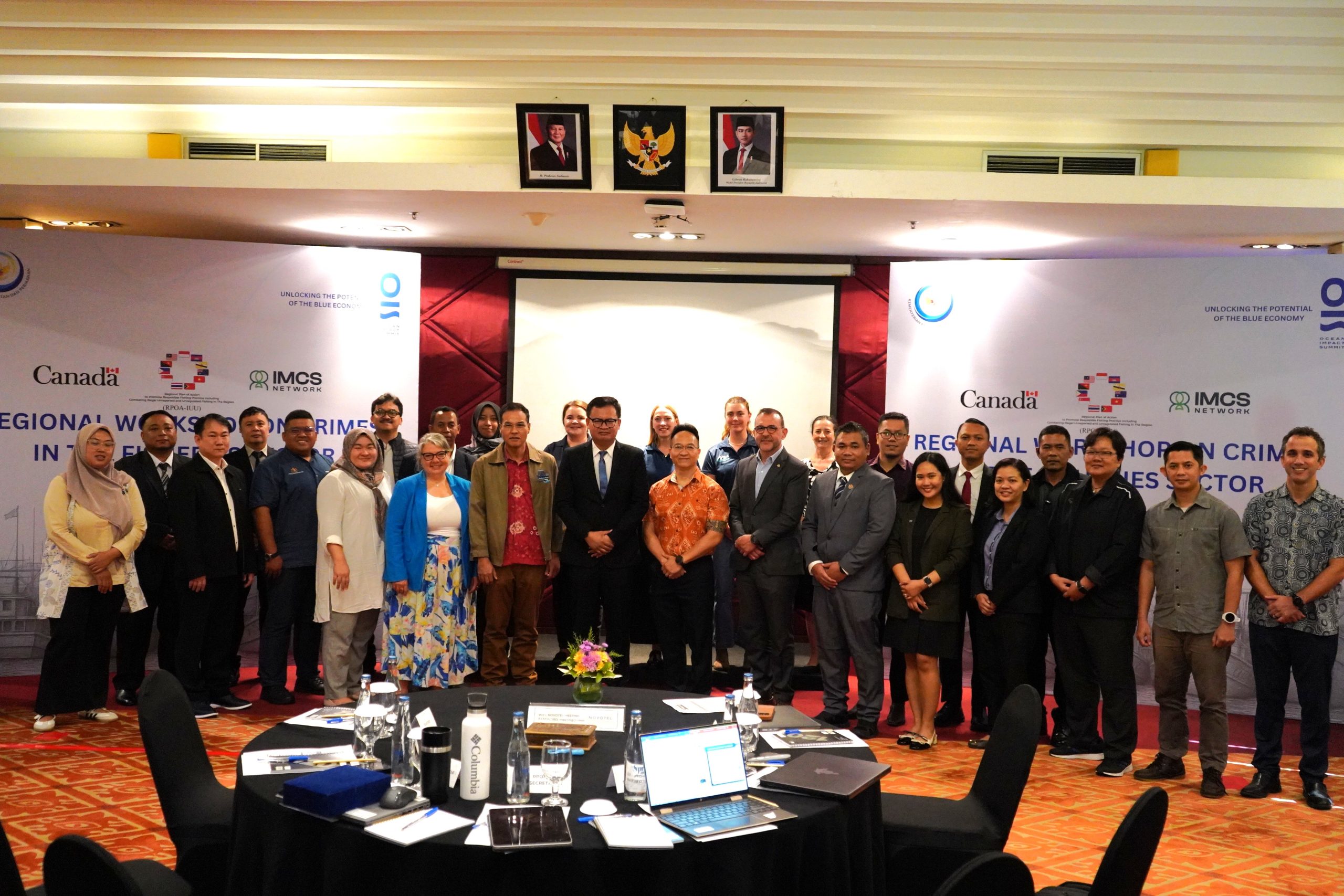
Building on this foundation, the RPOA-IUU Secretariat, in partnership with the International Monitoring, Control and Surveillance Network, successfully delivered the “RPOA-IUU Regional Workshop on Crimes in the Fisheries Sector”, held from 14 to 16 April 2026 in Bali.
Multi-Stakeholder Engagement and Capacity Building
The workshop brought together a range of key international and regional institutions, including the Australian Fisheries Management Authority, the Australian National Centre for Ocean Resources and Security, INTERPOL, and the United Nations Office on Drugs and Crime. This multi-agency participation underscored the importance of cross-sector collaboration in addressing fisheries crime, which often intersects with broader transnational criminal activities.
To enhance the effectiveness of the in-person engagement, an online training sessions were conducted in advance. These sessions established a shared understanding among participants and enabled more targeted, solutions-oriented discussions during the workshop.
Key Outcomes and Insights
The workshop highlighted the increasingly complex and transboundary nature of crimes in the fisheries sector, including document fraud, human rights violations, and fiscal crimes. Participants acknowledged that these offenses frequently extend beyond the mandate of fisheries authorities, requiring coordinated responses across maritime security, law enforcement, and judicial agencies.
A central outcome of the workshop was the recognition of the need to strengthen information-sharing mechanisms at both national and regional levels. In particular, participants emphasized the strategic role of RPOA-IUU focal points as primary channels for:
• Dissemination of fisheries intelligence and analytical outputs
• Issuance of regional alerts on emerging threats
• Coordination between fisheries agencies and broader law enforcement networks
Optimizing these focal points is expected to significantly enhance the timeliness and effectiveness of regional responses to fisheries-related crimes.
Contribution to Long-Term Regional Impact
Through this initiative, the RPOA-IUU Secretariat has strengthened regional capacity to better detect, analyze, and respond to fisheries crime. The combination of technical training, policy dialogue, and multi-agency engagement contributes to a more integrated and intelligence-driven approach to enforcement.
The continued support of partners such as the Canadian Department of Fisheries and Oceans remains instrumental in sustaining these efforts.
By fostering collaboration, enhancing institutional capacity, and promoting alignment with international legal frameworks, this initiative contributes to the long-term goal of ensuring sustainable fisheries management and strengthening the rule of law across the region.